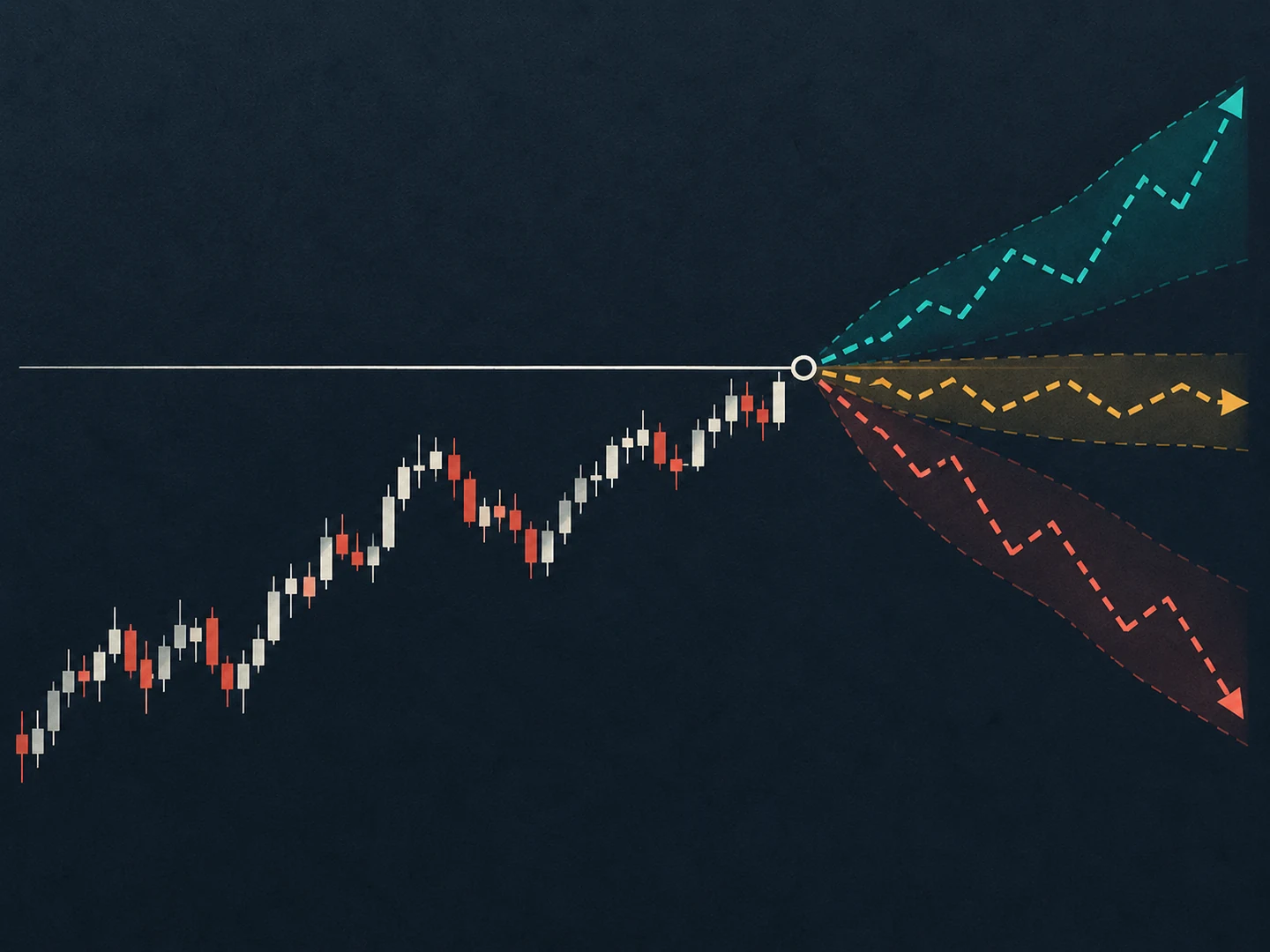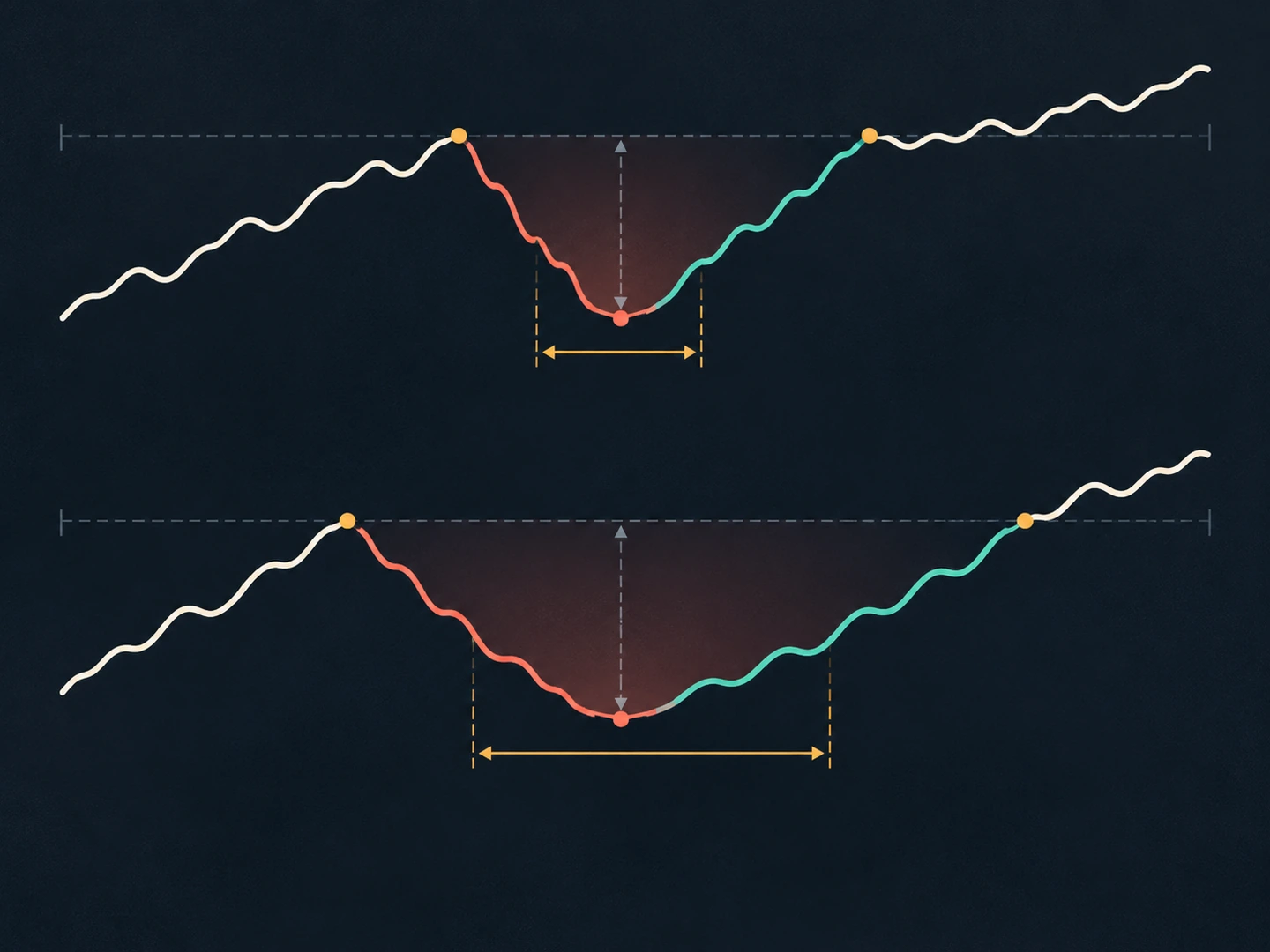
A stress test can end with a crisp number: a loss estimate, a drawdown, or a shortfall. The neatness of the output can make it feel like a forecast with an unusually bad ending. It is not. A stress test begins with a question about a specified shock and traces that shock through a model. Its result is conditional: if these assumptions hold inside the exercise, this is what the model produces.
The useful work happens before the number appears. Which question is the test meant to answer? Why do the assumptions belong together? And what does the result leave out? Those choices determine whether the exercise exposes a vulnerability or merely produces a dramatic figure.
What does a stress test start with?
A stress scenario is a chosen set of adverse conditions used to examine how an exposure responds. The conditions may be drawn from a historical episode, assembled as a hypothetical event, or built from a mixture of both. The exercise does not need to claim that the scenario is likely. Its job is to make the consequences of a stated set of assumptions easier to inspect.
Supervisory stress tests use this distinction explicitly. The Federal Reserve describes its 2026 severely adverse scenario as hypothetical and says it is not a forecast. The exercise assesses large banks under specified conditions. That scope matters: a regulatory bank test does not predict a market’s path, an individual account’s result, or the future performance of a trading method.
It asks a different question from a forecast
A forecast attempts to describe an expected or likely path. A stress test asks what a model would show if a defined adverse scenario occurred. The first is about an estimate of the future; the second is about conditional impact. A test result therefore cannot be read as the probability of its scenario or as a statement that the scenario will happen.
A one-factor sensitivity check is narrower still: it changes one input while holding the rest of the model fixed, to see how much that input matters. A broader scenario may combine several changes that are meant to fit together. The two exercises answer different questions. A sensitivity can isolate a driver; a scenario can examine how several assumed conditions interact.
Make the question narrower than ‘What if everything goes wrong?’
“What if everything goes wrong?” sounds thorough, but it does not define a useful test. A workable question names the exposure, the conditions being changed, and the outcome being examined. Without that scope, it is easy to combine unrelated shocks, overlook the assumptions that matter, and mistake a worst-looking result for a complete risk picture.
- What is being examined: a portfolio exposure, a rules-based method, a liquidity need, an execution assumption, or something else?
- Which conditions change, and over what horizon? State the relevant price, cost, liquidity, or timing assumptions without implying that any one path is expected.
- What stays fixed? A test may hold a position set, rule set, or model structure constant so the effect of the changed assumptions remains visible.
- What output answers the question? The useful measure might be a change in simulated loss, a drawdown profile, or a sensitivity to an execution assumption; no single metric describes every exposure.
- What would count as a limitation? Data gaps, unmodeled costs, unavailable liquidity, or a scenario that leaves out a relevant exposure can narrow what the result supports.
These questions are about the design of an analysis, not instructions to take a particular position or set a personal risk limit. They keep the exercise connected to a defined research or review objective.
A scenario needs internal logic
A scenario is more informative when its conditions form a coherent account of how the chosen stress could affect the exposure. If several variables move together in the test, the relationship between them needs to be explained. Otherwise, the model may be combining extremes that do not belong to the same story, or it may be missing the link that makes one shock matter to another.
The Basel Committee’s principles for bank stress testing call for scenarios to capture relevant risks, keep key variables internally consistent, and be sufficiently severe and varied for the exercise’s objective. Those principles apply to banks and supervisors, not as a rulebook for an individual trader. The broader analytical lesson is useful, though: a scenario needs a purpose, a rationale, and disclosed limits.
“Severe” does not mean inventing the most frightening combination imaginable. A test designed to examine a specific vulnerability can be challenging without becoming arbitrary. Nor can one scenario cover every way a model, portfolio, or market process might fail. A small set of distinct scenarios often makes the questions clearer than one catch-all event, provided each scenario has a reason for being there.
A hypothetical example: expose the assumptions
Consider a clearly hypothetical review of a generic rules-based method whose historical summary depends on a set of execution assumptions. The researcher wants to know whether the summary is sensitive to a fast price gap, wider assumed costs, or a delay between a signal and an exit. These are invented conditions for the exercise, not a description of a real market event, asset, strategy, or product feature.
One check could vary the assumed cost while leaving the other inputs unchanged. A separate scenario could pair a gap with a delayed exit if the rationale for the test is that both affect the same execution path. Keeping these versions separate makes it easier to see which assumption drives a change. If every input changes at once, a different output may be difficult to explain.
The report might show that a summary changes materially under one set of assumptions and less under another. That is a sensitivity finding about the model as specified. It does not establish how often either condition will occur, whether the method will behave the same way outside the data, or which scenario is more probable. The point is to learn where the conclusion depends on an assumption.
Read the result as a conditional statement
A useful stress result can be written in a plain form: under scenario A, with data B and model assumptions C, the output changes by D. That sentence keeps the result attached to its inputs. Remove the conditions and the number may sound broader than the exercise can support.
The Bank for International Settlements’ Financial Stability Institute notes that stress tests can identify exposure to specified events but do not predict the probability of those events. It also points to judgment in scenario selection and to the importance of data and model quality. Those limits are not footnotes to discard after the test; they are part of how its result should be interpreted.
A stress test can miss risks that were not represented, or produce a different result when its data, execution rules, or model structure changes. Historical observations may help inform a scenario, but they cannot guarantee that the next stressful period will follow the same sequence. A clean output is still conditional on what the test was able to represent.
A compact report makes the limits visible
A short report does not need to hide behind a single headline number. It can give readers enough context to understand what was actually tested:
- Purpose: the question the exercise was designed to answer.
- Scenario: the conditions, relationships, and time horizon being assumed.
- Method: the data, model, execution assumptions, and items held constant.
- Result: the outputs that changed, including sensitivity to alternative assumptions where relevant.
- Limits: important risks or conditions that the exercise did not represent.
If a result changes sharply when one plausible assumption changes, that dependence is part of the finding. Reporting it may make the conclusion less tidy, but it gives the reader a better account of how much weight the model can carry.
Stress testing is useful when it stays in its lane
A stress test is not a promise of resilience and not a forecast in disguise. It is a structured way to ask what a stated set of adverse assumptions reveals about a defined exposure. The answer can help identify a dependency, a missing input, or a part of the model that deserves closer review.
The result is most useful when its conditions travel with it: what changed, why those changes belong together, what the model held constant, and what stayed outside the test. Read that way, a stress test is a map of a conditional vulnerability. It is not a route forecast, a probability estimate, or evidence that a future outcome is safe.
- See how conditional scenarios make a trading plan testable
- Explore how exposures can move together under stress
- Read why drawdown has a duration as well as a depth
Sources and further reading
- 2026 Stress Test ScenariosFederal Reserve Board
- Stress testing principlesBasel Committee on Banking Supervision
- Stress testing – Executive SummaryBank for International Settlements, Financial Stability Institute